
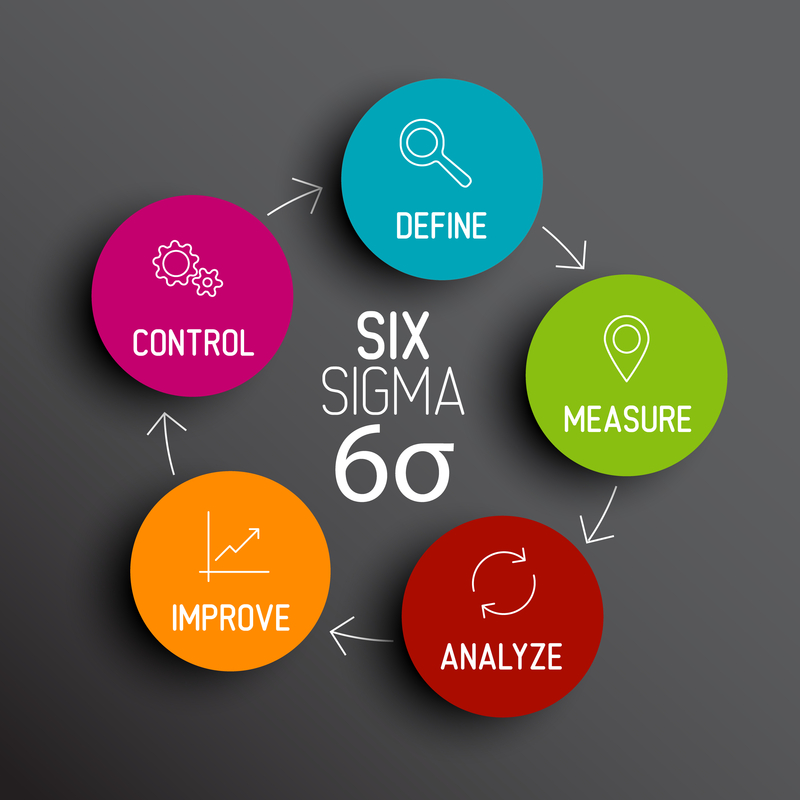
This Six Sigma Green Belt course is the next step to Yellow belt certificate. After understanding the basic methodology of DMAIC and seven QC tools this course will equip the learner with higher level of problem solving. This course is a little deeper in Problem solving.
In this course the methodology is explained in detail with statistical concepts like sampling data collection, measurement system, data analysis, Root cause analysis, Improvement methods & control techniques. practical examples and numerical examples will discussed and the learner is required to be able to use scientific calculator. Assignments will be given and learner is required to complete before the next session, this helps in learning and assimilating the concepts. There will be an examination at the end of the course and those who qualify will be awarded certificate.
Course duration : 48 Hours
The course syllabus is as follows.
1.Six sigma Definition
2. Quality Concepts- Evolution, contributions of Shewhart, Deming, Juran, Crosby, Feignbaum, Ishikawa and Taguchi.
3..Six sigma Projects and linkage to Organizational Goals
4.Organisational Drivers & metrics – Profit, Market share, ROI, NPV, Payback, Balanced score card
5. Lean Principals – Value, Traditional Vs Lean Thinking, Value stream Mapping, Toyota Seven Wastes
6. Design for six sigma DFSS, DMADOV, FMEA
7. Define Phase – Project Identification, Process Elements, Benchmarking, Process inputs & outputs, Owners & stake holders, Voice of customer (VOC), QFD
8. Project Management Basics – Project Charter, Problem Statement, Project Scope, Goals & Objectives, Project Metrics, Project Planning tools, Project documentation, Project risk Analysis, Project Closure.
9. Management and planning tools – 7 new QC tools ( Affinity diagram, Interrelation diagram, Tree Diagram, Prioritisation Matrix, Matrix diagram, Process decision program chart ,Activity Network Diagram
10. Business Results – Defect per Unit (DPU), Defects per million opportunities(DPMO), Throughput yield, Parts per million (PPM), Rolled throughput yield (RTY), Cost of Quality
11. Statistics -Descriptive Statistics, Inferential statistics, Population, Sample, Raw & arranged data, Stem & Leaf diagram, Measures of Central Tendency (mean, Median, Mode), Measure of Central Tendency ( Range, Standard deviation), Probability, Central limit theorem, Distributions( Normal, Binomial, Poisson, Chi square, t distribution, F distribution), Hypothesis Testing, ANOVA
12. Measurement System Analysis – Gage R & R, Precision to tolerance Ratio(PTR), Bias, Stability, Percent Agreement
13. Measurement & Modelling relationship between variables – Correlation, Multivariate analysis, Transfer function
14.Design Of Experiments- Factors, trials, randomisation, replication, Response, Effects ( main ,and Interaction), Noise & Control factors, Expriments ( Full factorial anf fractional Factorial)
15. Root Cause Analysis – 8D,Why why, Is/Is not, B Vs C, Cause & Effect Relational Matrix, Root cause tree, FMEA
16. Lean Tools – 5S, Kaizen, Kanban, Pokayoke, TPM, Standard System, JIT, Pull System
18. Control – Statistical Process control, Control Charts Variable(Xbar-R Chart, Xbar-S chart, Median Control Chart) Attribute( p Chart, NP chart, moving range chart, U chart, C chart), Process control Plan
17.Lean tools for process control – Lead time, Takt time, OEE, MTTR, Visual Factory